Win the argument
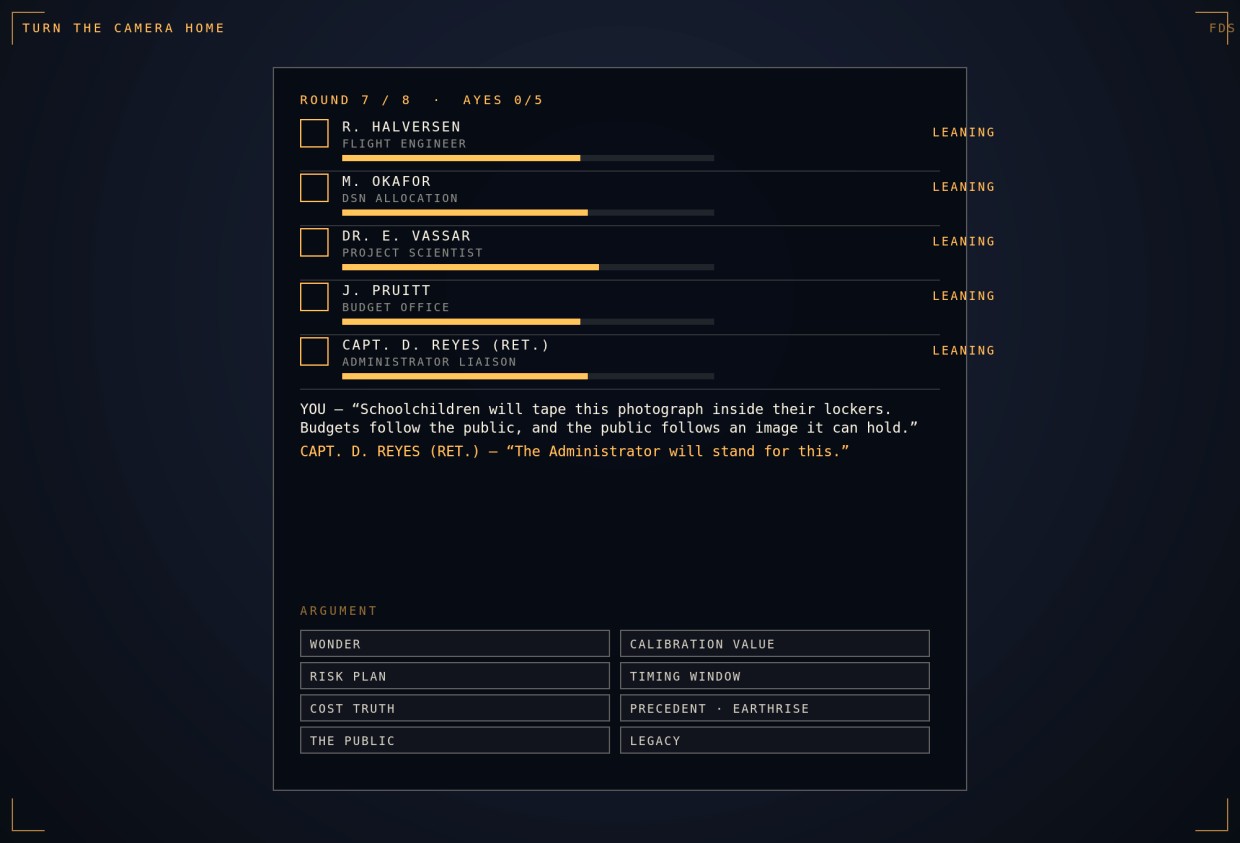
Read five people in the room and choose the case each might accept: risk, cost, precedent, science, or wonder.
 BRAND NEW COLORS
It is 14 February 1990. Voyager 1’s cameras are about to shut down forever. Win one last argument, fly the Family Portrait, and find Earth inside a ray of light.
Voyager’s planetary tour is over. The engineering case for another photograph is thin: the spacecraft is six billion kilometres away, power is finite, the cameras are old, and the Sun can burn the image tubes.
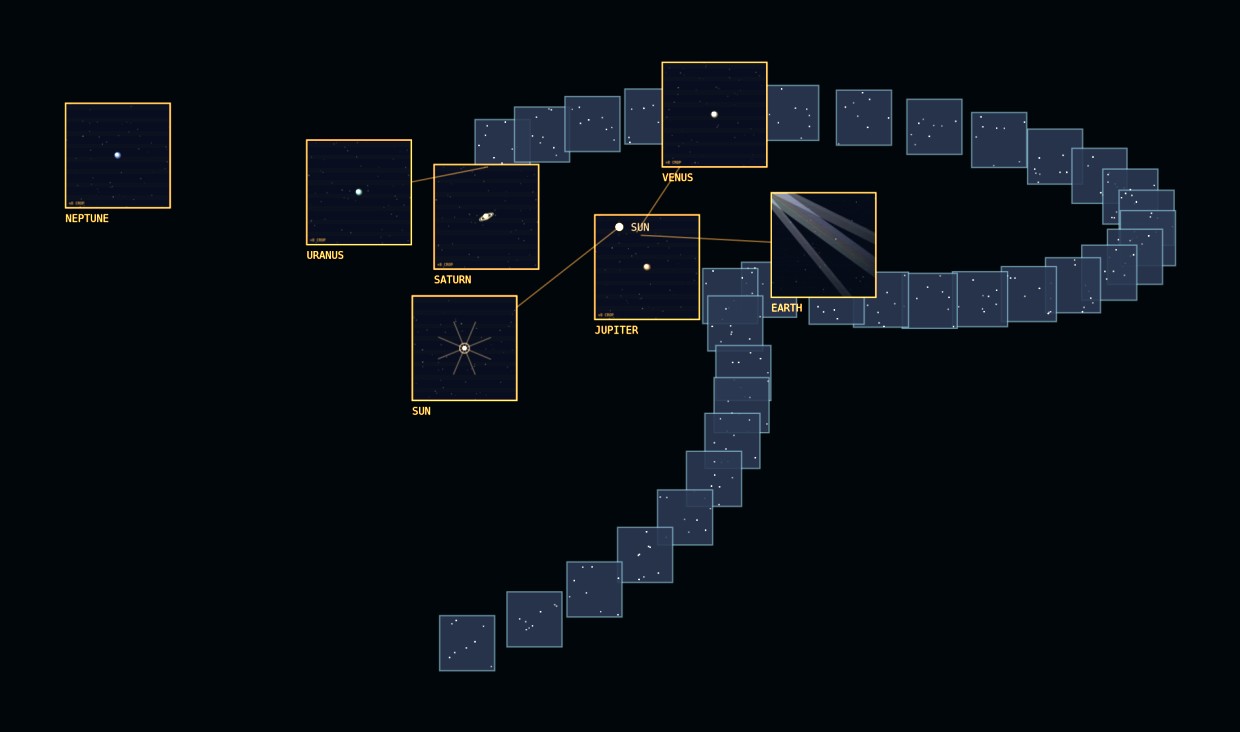
The human case is harder to dismiss. The game puts you inside that last look: make the argument, retrace the gravity assists, budget the watts, expose the sixty-frame mosaic, schedule the Deep Space Network, and assemble the Family Portrait.
The operating detail is the game. Wonder has to survive practical objections, and meaning has to fit inside a power budget.
The specificity is structural: it changes what the player can do, what each choice costs, and what the ending remembers.
Read five people in the room and choose the case each might accept: risk, cost, precedent, science, or wonder.
Use Jupiter and Saturn the way Voyager did, then take the Titan pass that lifts the spacecraft above the plane of the planets.
Protect the optics, choose the camera and filter, manage a shrinking power margin, and sweep toward the Sun.
Schedule Madrid, Goldstone, and Canberra around a weak signal, a turning Earth, and other missions.
Lay out the mosaic you actually made, then fall through one sunbeam toward the point the whole mission came from.
The Pale Blue Dot is often remembered as a photograph and a paragraph. The game restores the machinery around both: the decade of persuasion, the geometry that made a solar-system portrait possible, a scan platform pointed too close to the Sun, magnetic tape waiting five and a half light-hours away, and three ground stations sharing one turning planet.
That operating detail is the game. Wonder has to survive a room full of practical objections. Meaning has to fit inside a power budget. A picture of everyone depends on a chain of people doing precise work for an image with almost no scientific value.
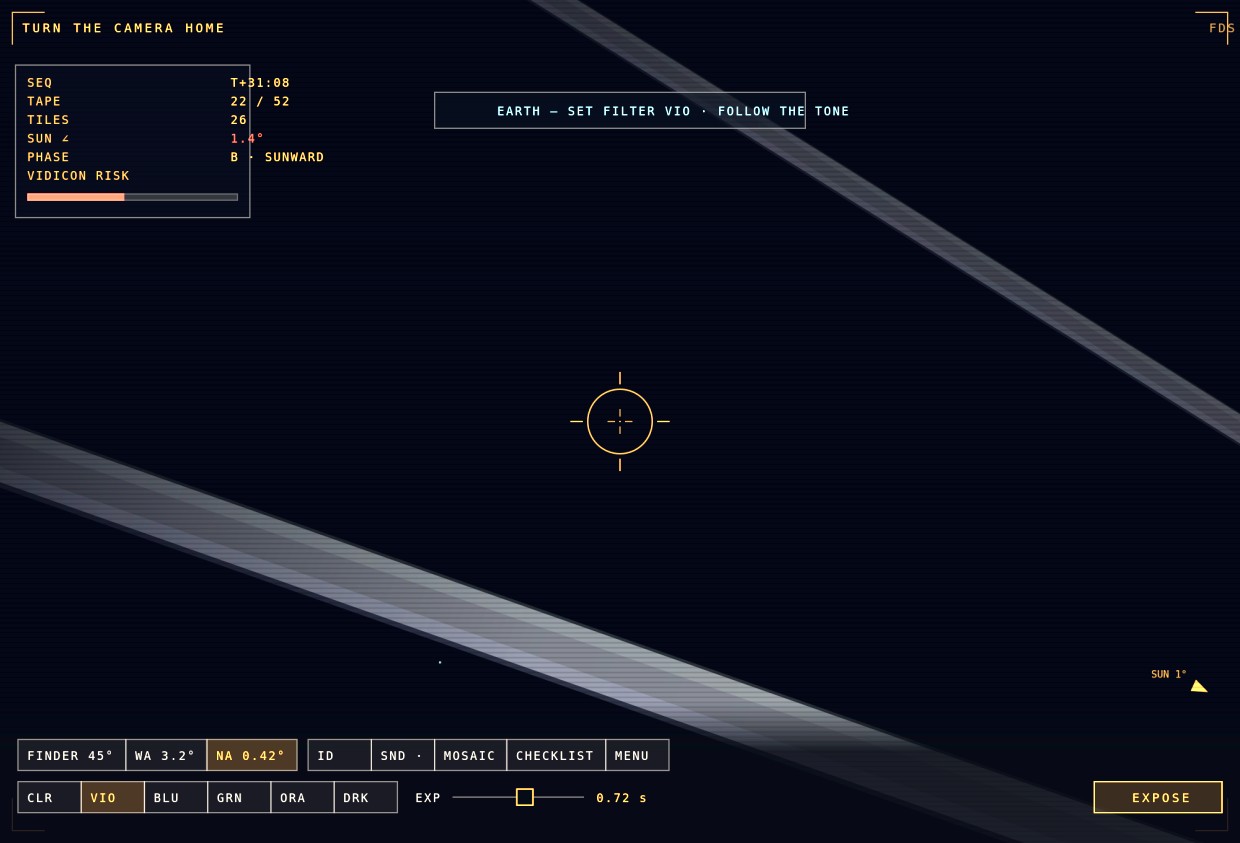
The camera act gives you a finder, wide- and narrow-angle cameras, filter wheels, exposure time, a tape counter, and a real reason to watch the Sun angle. The outer planets are practice. Earth is the test.
A proximity tone quickens as the reticle closes on the right point. The image offers almost nothing: a tiny signal inside scattered glare. Finding it asks for attention generous enough to treat noise as home.
No. Each act supplies the mission detail it turns into a decision. Prior knowledge changes what you recognize, not whether you can play.
About twenty-five minutes for all five acts. The mission menu lets you return to an unlocked act during the same run.
No. Sound is recommended for the Earth hunt’s proximity tone, but the full game remains playable with sound off.
Free in a modern browser on a phone or desktop. There is no app, install, account, or email gate.
It is a historical game. The instruments, geometry, and timeline come from the real Family Portrait; player-facing meetings and trade-offs are dramatized.
Yes. The final act can save the portrait your run assembled, including the Earth frame you made.
This game demonstrates the studio’s central claim: a real place, practice, community, or text contains better game mechanics than a broad theme pasted on later.
Follow the mechanics into another place, practice, memory, or shared text.
The playable build is free. If this makes you think of a world only your people would recognize, that may be the next game.