Crisis response
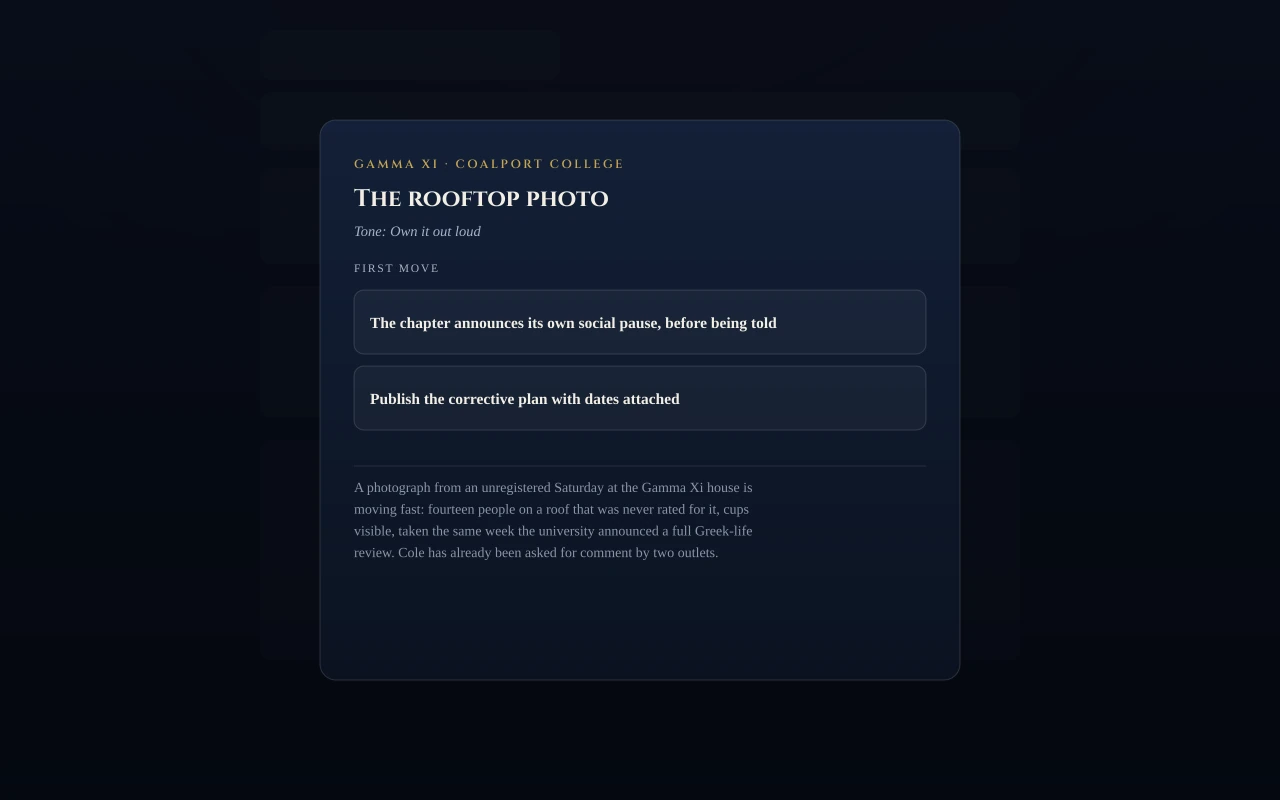
Choose a tone, make the first move, bring in the right partner, then cover what the first response could not.
 BRAND NEW COLORS
Spend one season as a regional advisor. Every month asks what deserves your attention and what kind of advisor the chapters learn to trust.
By May, every chapter carries the record of what you noticed and what you missed. The expansion group has either earned its charter or shown you why it did not.
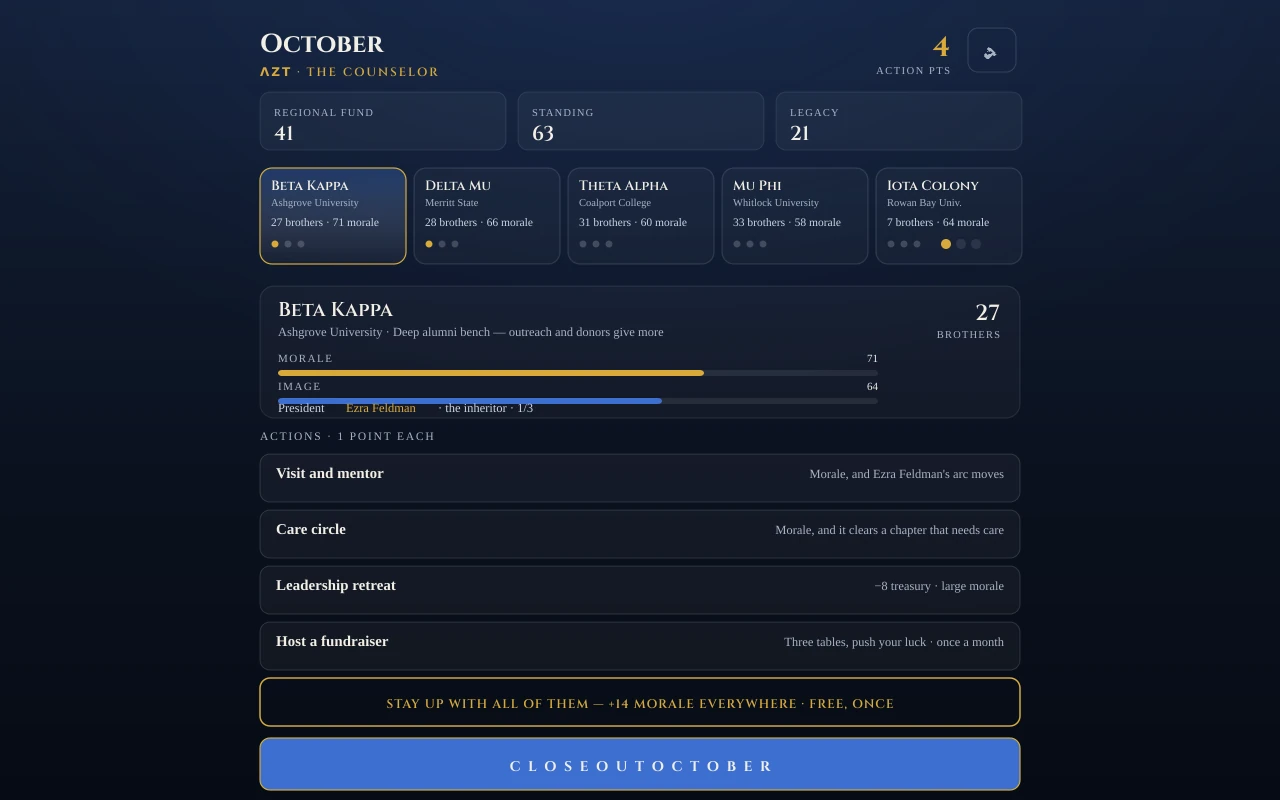
A quieter Legacy score tracks the year people will remember. Presidents develop when you show up. Members run into real walls. Contracts hide bad lines. Strong outcomes grow from ordinary decisions made early enough.
Good Standing is the public demonstration game from Chapter Advisor Games, an initiative of Brand New Colors.
The specificity is structural: it changes what the player can do, what each choice costs, and what the ending remembers.
Choose a tone, make the first move, bring in the right partner, then cover what the first response could not.
An allegation arrives. Six conversations are possible; there is time for three. Evidence has weight.
A contract contains one bad line. Find the auto-renewal, shifted liability, or grant restriction.
Venue, guest plan, and safeguards combine into the night people talk about later—for very different reasons.
Organization-specific processes turn recruitment into decisions rather than trivia, including the file that carries a note.
Three donor tables. Take the pledge or press your luck, with the relationship sitting behind the number.
The public game demonstrates the engine with fictional organizations and campuses: terminology changes with the organization, crisis modeling rewards care, contracts demand literacy, and strong paths teach the reasoning behind their outcomes.
A custom season can author the same structure around one real organization—its vocabulary, policies, calendar, recurring failures, and the weeks advisors wish somebody had let them practice first.
Choose one of eight fictional organizations and an advisor archetype: Diplomat, Builder, Steward, or Counselor. Each carries a signature move that can be spent once.
The engine includes crisis response, inquiries, contracts, social planning, recruitment, intake, and donor conversations. A custom season can use the same structure around a real organization’s vocabulary, policies, calendar, and recurring situations.
No. The demo explains the situation before asking for judgment. Experience changes what you notice.
No. The simulation is built around prioritization and consequences. Strong choices make their reasoning visible.
You can choose a quick or standard season, then set the difficulty before the first month begins.
Yes. The engine can be authored around a real organization’s vocabulary, policies, calendar, and recurring advisor situations.
The client receives the commissioned game and source handoff under the agreed assignment or license. Brand New Colors retains its pre-existing tools and generalized craft.
This game demonstrates the studio’s central claim: a real place, practice, community, or text contains better game mechanics than a broad theme pasted on later.
Follow the mechanics into another place, practice, memory, or shared text.
The playable build is free. If this makes you think of a world only your people would recognize, that may be the next game.