Jewish Community Simulator · community management sim · hosted at Shalom Desk
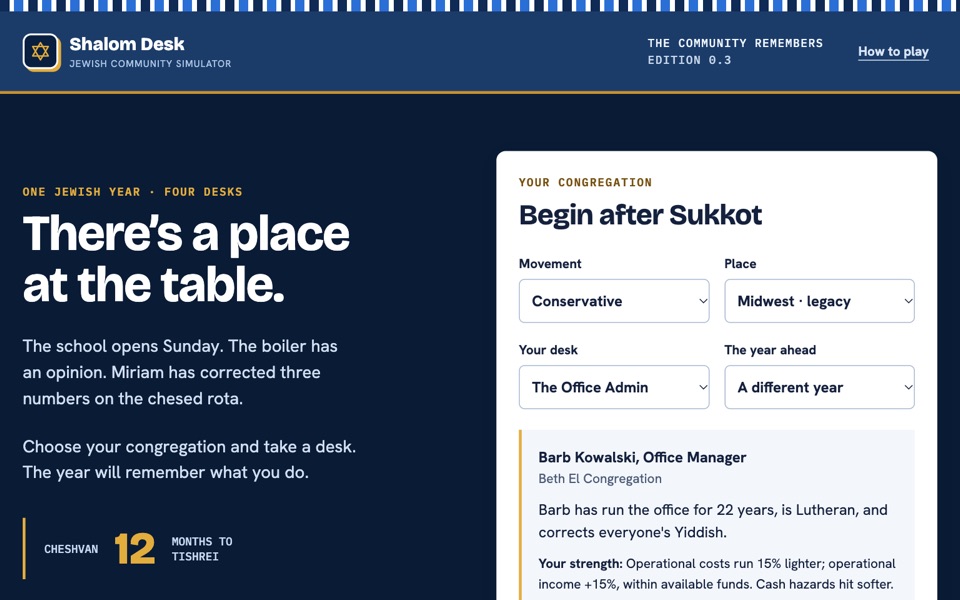
One Jewish year. One very old boiler.
Pick a desk—rabbi, cantor, education director, or office manager—and lead a fictional congregation from just after Sukkot through the year. The dramatic decisions matter. So does whether somebody remembered the dues statements.

What this is
A management game about the work nobody applauds.
Most management games manufacture a crisis every minute. Jewish Community Simulator is comfortable handing you a Tuesday. The building is old. A family has quietly gone quiet. Religious school has a carpool problem. The bulletin still has to go out.
Every congregation contains four staff roles and a building full of work that belongs to somebody. Your own queue matters more when you neglect it, because invisible work still has consequences.
A project of Shalom Desk, built by Jacob Sager at Brand New Colors.
How a month works
Four beats, twelve times.
The docket
Standing business, what is open, what has slipped, and the thing your particular desk noticed first.
The decision
One call the month turns on. The trade-offs are visible before you commit; some choices only appear for the role you picked.
The work
A limited pool of attention across the work your role can actually do. The rabbi cannot file every grant. The office manager is not doing hospital rounds.
The report
Dues collected, tuition, gifts, payroll, upkeep, attendance—and the ordinary community life that happened whether you scored it or not.


The world generator
Before you sit down, the congregation already has a past.
Four Jewish movements cross with four kinds of place and a larger set of institutional histories to create 192 congregations. One may be a 1927 building with no parking. Another is a Sun Belt community inventing its traditions in real time. A small congregation can cover a hundred-mile radius.
The differences alter the work. An eruv can need checking. A supervised kitchen creates its own obligations. A community in the middle of a merger conversation arrives with a different year already underway.


Why it belongs here
Institutional knowledge becomes a world.
This is the hyper-niche game idea at full resolution. A congregation is not a generic nonprofit with Jewish vocabulary painted on top. Its calendar creates work. Its building creates work. Its leadership roles reveal different information, and community memory changes what an ordinary decision means.
That specificity is the game system. The same logic can turn a profession, association, workplace, or community into something playable without sanding away the parts insiders actually recognize.
Take a seat at the desk.
No account. No email. The year starts just after Sukkot.