
A custom furniture shop arrives with a queueing problem. Leads wait before they become jobs. Jobs wait for deposits. Deposits become lumber. Lumber waits for a bench. A bench waits for the person who knows how to do the joinery.
The people are systems.
A master joiner can refuse a shortcut. A CNC operator can outgrow the role you gave her. A finisher can know he has been underpaid for longer than you have owned the shop. These are not character bios sitting beside the strategy. They determine capacity, quality, risk, and the future of the crew.
Saying yes has a cost.
A profitable job can still be impossible. The delivery date may collide with work already promised. An honest waste buffer can lose the bid. A deposit improves cash and immediately creates the lumber bill behind it.
The game gives the owner twelve weekly time blocks because the calendar is the shared resource underneath everything. Calling a lead, pricing a job, solving a bench problem, and going to a Wednesday jam all spend the same thing: part of a finite week.
A shop that cannot afford its owner’s absence is not yet stable, even when every bench is full.
Watch one decision move through the shop.
In Houston Custom Wood Shop, a studio original, drawing the restaurant concept spends two of the week’s twelve time blocks. The job then waits for a bid.
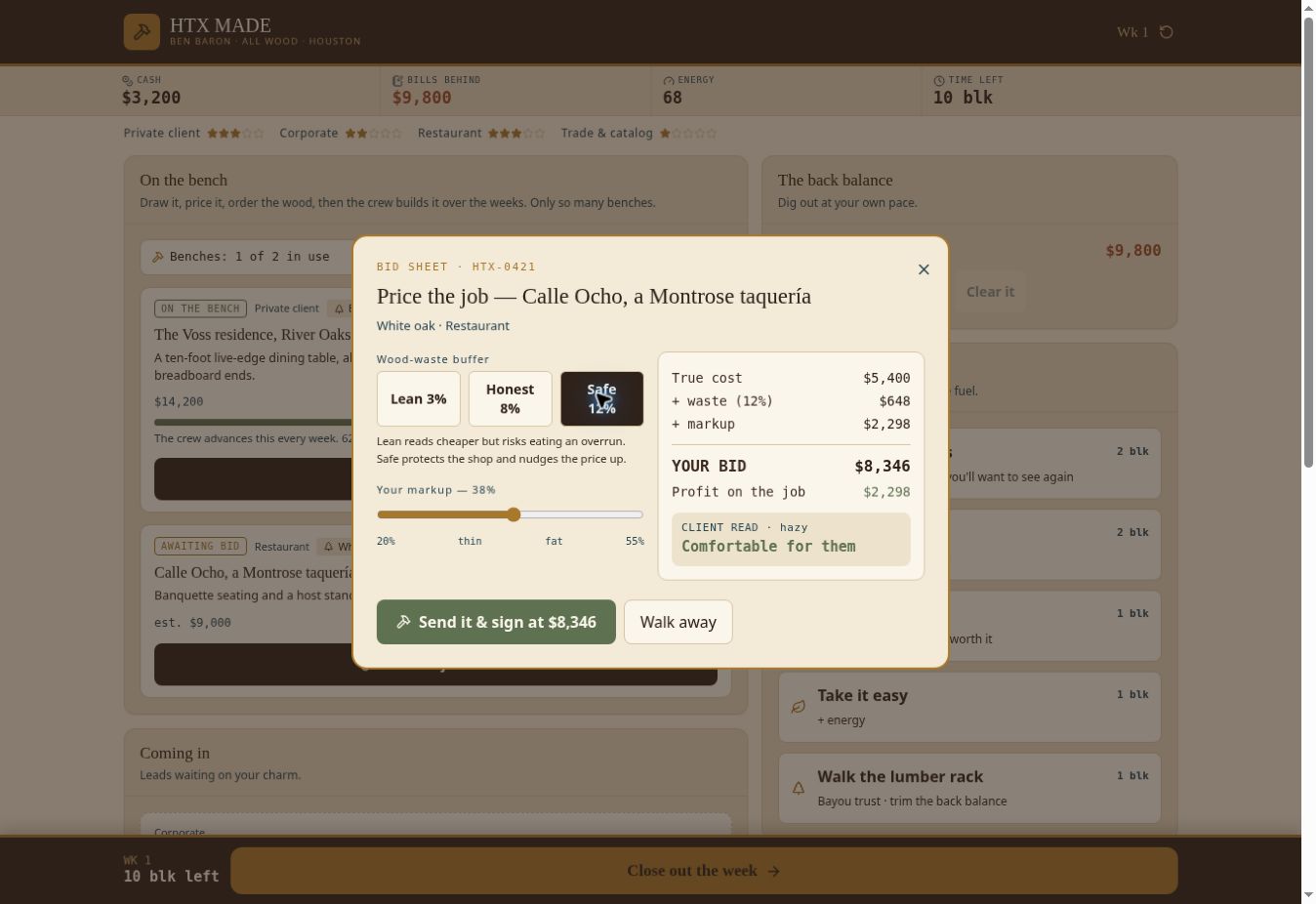
At a 38% markup, the 8% waste allowance produced an $8,048 bid in this playthrough. Switching to 12% raised it to $8,346. The extra protection has a price the customer can accept or refuse.
When this bid was accepted, a $2,921 deposit arrived and $3,756 of wood went on order. Available cash fell from $3,200 to $2,365. Winning the work made the immediate cash position tighter. The job then waited for wood to arrive around week three.
The player has to live with what the estimate commits the shop to. Price, cash, time and bench space belong to the same decision.
Design shifts from invention to selection.
Once the real operating logic is visible, the question is no longer “what game mechanic should we add?” It is “which three pressures reveal this world most honestly at browser-game scale?”
That is the hyper-niche advantage. Specificity does not merely improve the copy. It supplies the actual game.