Immediate
You arrive at the playable idea quickly. There is no long setup proving the game read the story.
A five-minute arcade game built around the central image of Salinger’s short story.

Salinger’s 1948 short story becomes a game small enough to finish in one sitting. A short source gets a short form.
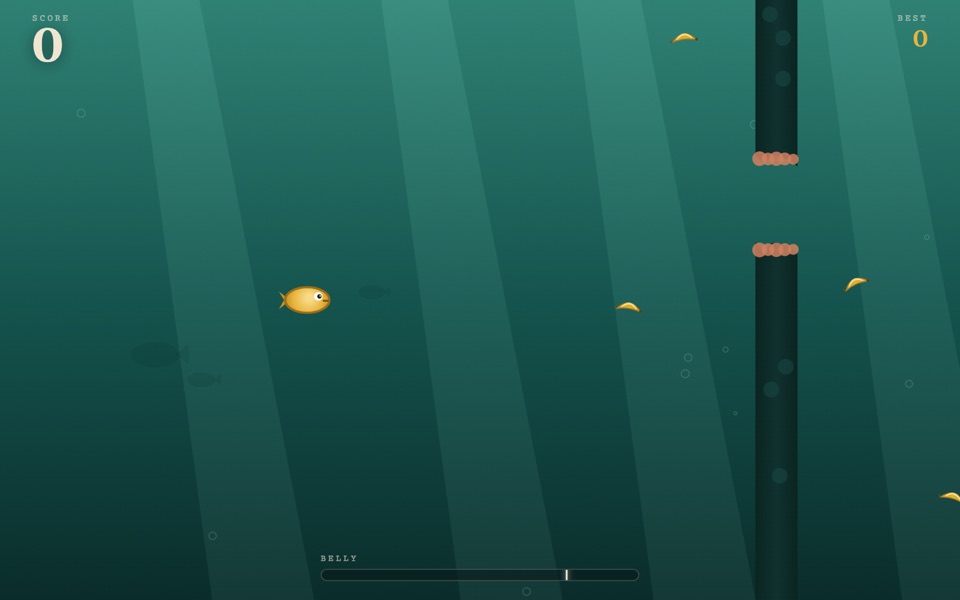
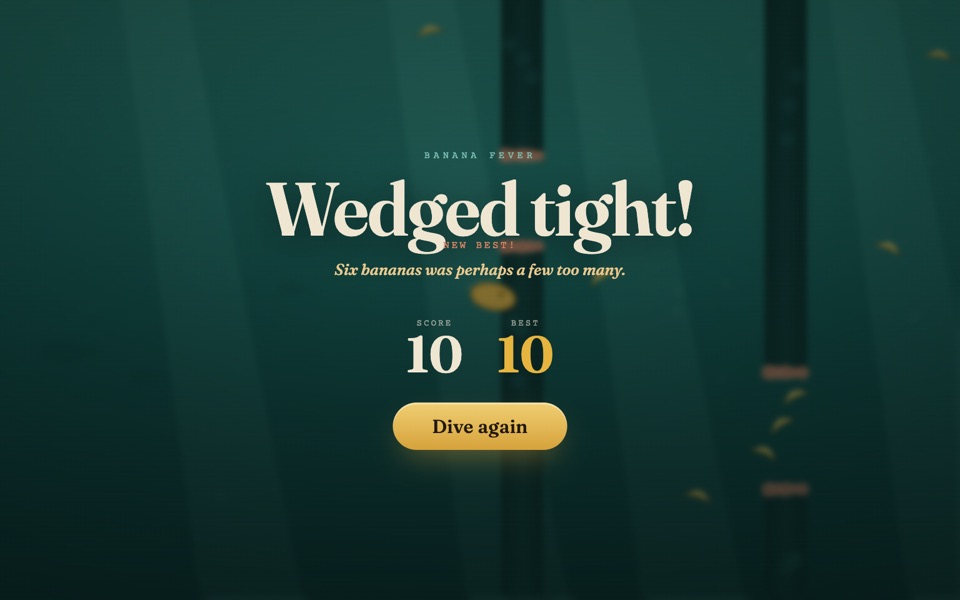
The game keeps returning to the story’s invitation: see more bananafish.
This is an arcade adaptation rather than a miniature visual novel. It takes the image seriously enough to build the whole interaction around it, then gets out before the idea wears thin.
The specificity is structural: it changes what the player can do, what each choice costs, and what the ending remembers.
You arrive at the playable idea quickly. There is no long setup proving the game read the story.
The arcade structure makes repetition part of reading. The image becomes stranger as you stay.
Five minutes is enough to make the connection and leave air around it.
An arcade frame does something faithful here: it lets an odd, bright surface carry weight without announcing it.
The community is readers who already carry the story’s images in memory. They do not need a survey of mid-century American fiction; they need the adaptation to notice the detail they noticed. That standard is useful even for a player meeting the image for the first time.
The niche value comes from concentration. A broad “literary game” could decorate itself with typewriters and book jackets. This one has a particular story to answer to, so its form can be smaller and much more exact.
Brand New Colors scales a literary game to its source. Novels became longer retellings; this short story became an arcade.
A knowledgeable reading audience does not need a survey of mid-century fiction. It needs the adaptation to notice the detail it noticed.
No. Knowing Nine Stories changes what you notice, but the game works on its own.
About five minutes. The short running time is part of the design.
In your browser on its hosted page.
Nothing. Open it, play it, close the tab when you are done.
This game demonstrates the studio’s central claim: a real place, practice, community, or text contains better game mechanics than a broad theme pasted on later.
Follow the mechanics into another place, practice, memory, or shared text.
The playable build is free. If this makes you think of a world only your people would recognize, that may be the next game.