
Run a business that no longer lives only in your head.
Your strategy, your pipeline, your delivery, and the money picture — read once, then kept connected in one workspace, so the business stays legible whether or not you’re the one holding every thread.
Clarity you can hand to someone else.
One system covers the four things that keep a business legible. You walk away able to see it, staff it, and step back from it.
Numbers you trust
Invoices, expenses, and project margins connect to the work they belong to. The month’s cash position rolls up automatically — so the money picture is something you read at a glance, not reconstruct from three tools and a phone call to the bookkeeper.
BookkeepingA business your team can read
Every deal shows its stage. Every project shows its owner and status. What closed this month, what ships this week, who is waiting on what — surfaced in shared views your team can open without routing through you.
Operational transparencyKnowledge that stays when people leave
Procedures, client history, pricing logic, and the documented version of “how we do this” live attached to the work they describe. The things currently in your head begin compounding as structured, searchable information your next hire can actually use.
Knowledge managementA foundation built for AI
AI tools can only help you when your data is structured and relational — not buried in inbox threads and scattered spreadsheets. The Business OS is that foundation. The system gets more capable with every record you put into it.
AI buildingA business only you can read can’t be grown, staffed, or stepped away from.
Every quarter it runs on your memory, the same tax compounds. A deal closes and the handoff to delivery happens by a hallway conversation that nobody wrote down. A project finishes thinner than it was scoped because the overrun surfaced at invoicing instead of mid-stream. A capable hire leaves inside six months because the work was never documented enough to own. A client asks where things stand and the honest answer is “let me find out.” Each is structural — what happens when a real business runs without a real system — and each one quietly charges against the revenue and the reputation that took years to build.
Get the Business OS — $99The home view of your business.
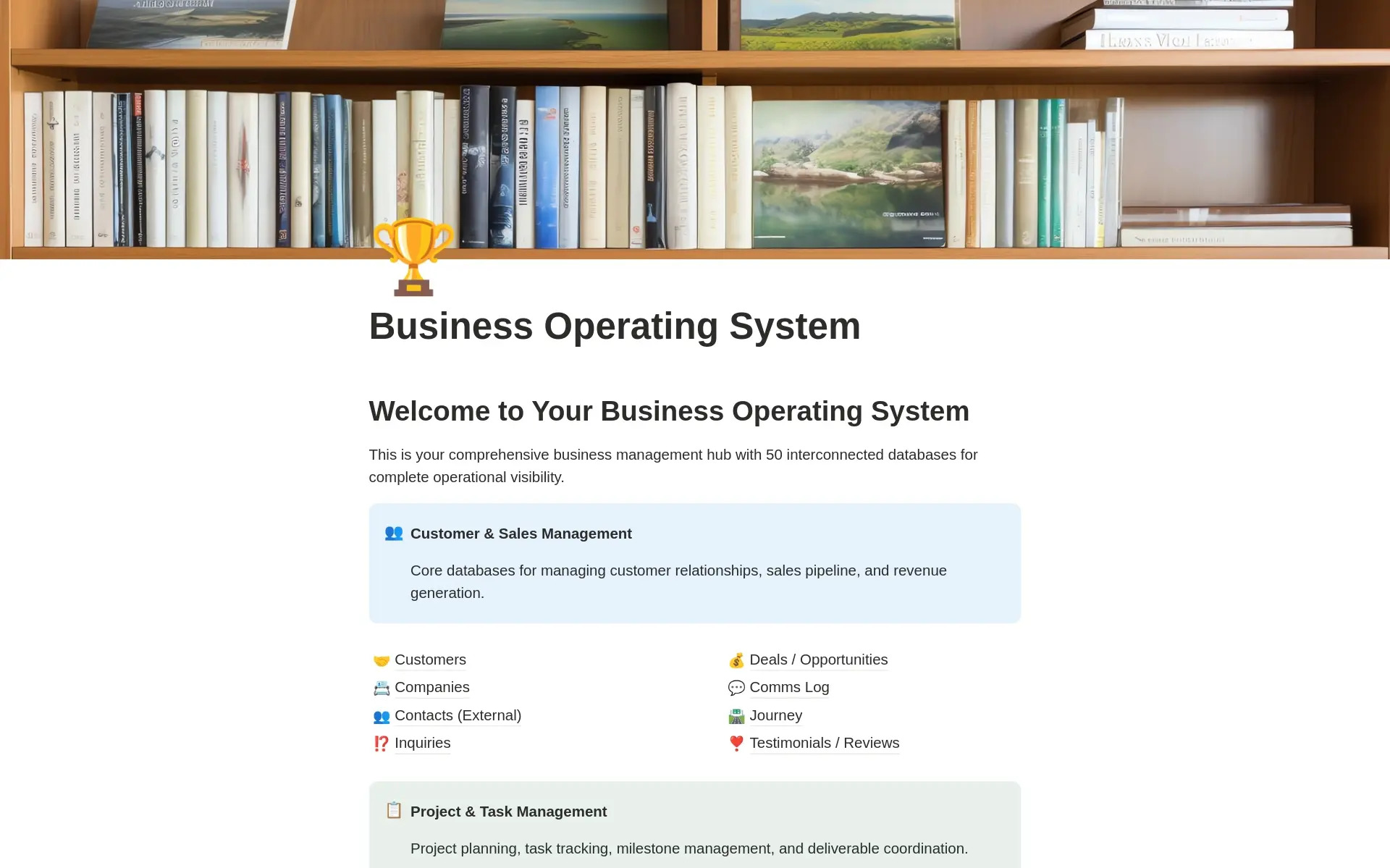
Eight functional areas. About fifty connected databases.
Every record lives once, inside one connected workspace. Each area below holds the databases that run that function, and the relations between them update on their own — so a closed deal reaches Projects, Finance, and everywhere else the work appears.
Customer & Sales
Customer relationships, sales pipeline, and revenue generation.
Projects & Tasks
Project planning, task tracking, milestones, and deliverable coordination.
Team & HR
Human resources, team coordination, role management, and operating procedures.
Finance
Payments, vendors, invoicing, budgeting, and financial tracking.
Documentation & Knowledge
Knowledge base, SOPs, and the reference layer the team can read.
Technology & Systems
Automation, AI agents, system blueprints, and technical infrastructure.
Analytics & Reporting
KPIs, dashboards, reporting, and the business-intelligence layer.
Marketing & Content
Campaigns, content assets, lead generation, and marketing operations.
A System Management layer sits underneath the eight areas, holding the directory, system maps, and views that keep everything legible.
The read comes first. The build follows the diagnosis.
A system installed over an unread business just adds another place to look. The Business OS was built from reading how owner-led businesses actually run — so the structure answers the problems the read names.
Diagnosis before architecture
The sections, connections, and roll-ups were shaped by following real owner-led businesses end to end — reading where the margin bled, where signal got lost, and where decisions piled onto one desk. The architecture answers what the read found, so you build the right thing first.
One system for eight functions
Strategy, sales, delivery, finance, marketing, operations, team, and knowledge — held in one connected workspace where the relations between them update automatically. The bookkeeper, the project lead, and the owner each open the same system and see the right view for their role.
Built to outlast you
The template ships with the structure an owner-led business actually uses — a proven starting point. Your business might run lean on team and heavy on delivery, or the reverse. Every database, stage, and status is yours to retool, and the structure keeps fitting as the business grows.
What Notion is — and why this lives there.
You don’t need to know Notion before you start. Here’s what matters: it’s a workspace tool where the same information can look like a table, a board, a calendar, or a dashboard depending on who’s looking. One workspace, the right view for every role.
Picture a document that also behaves like a relational database. Your bookkeeper opens a table of invoices. Your project lead opens a board of active work. You open the operations dashboard. Same data, no double-entry, no one working from a different version.
Notion is flexible enough to hold eight functions, live financial roll-ups, and a growing knowledge layer in one workspace — without a per-seat software stack or an IT project. Nothing else wires a client record to its deals, projects, invoices, and documents in one connected place.
Gentler than the CRM or project tool you’ve already abandoned once. Notion works like documents and tables your team already knows. The setup guide walks you through the first week. Most businesses are running confidently within days of duplicating the template.
AI tools can read and act on structured, relational databases in ways they can’t touch an inbox or a spreadsheet. Every procedure, client note, and pricing rule you add becomes queryable — building infrastructure that compounds, rather than getting organized once and forgotten.
You’ve been holding the whole business together. That’s the problem to solve.
The part nobody tells you
Being the person who knows everything feels like control. It’s actually the ceiling. The business can only move as fast as your attention, and your attention is finite. Each new client and hire stacks more onto that — until the limit on growth turns out to be you, and a week away quietly costs the business its momentum.
Why this lives in Notion, in plain terms
Notion is a workspace tool — not an app you buy to solve one problem, but a flexible environment where you build the structure that fits your actual business. The Business OS gives you that structure pre-built from real owner-led operations, so you duplicate it once and start loading real work the same day. No license per teammate. No IT setup. Works on any device, from anywhere.
Who made it, and why
Brand New Colors is Jacob Sager’s operating practice — built on a close reading of how owner-led businesses actually break: not at the work, but at everything surrounding the work. The Business OS came from following real businesses through a full cycle and encoding what was genuinely there. The conviction is that the structure should outlive the person who built it.
Start at $99. Climb when the business asks for it.
Every rung starts from the same workspace — the complete Business OS, every database connected, all eight functions ready. What changes is how much of the loading and shaping you do alone, and how much I do alongside you.
- The full Business OS workspace duplicated into your Notion
- ~25 connected databases, set up and ready to use
- Email-only support for 90 days
- One-time purchase — yours forever
- Everything in The Template
- 60-minute kickoff call walking your workspace
- Two async check-ins (email or Loom) over two weeks
- Help loading your real records into the right places
- Email support continues for 90 days
- Everything in Guided Start
- 45-minute discovery call to read your operation
- Workspace reshaped — renamed sections, custom properties, new databases where the shape doesn’t fit
- A short workspace brief: what each section is for and how to use it
- 60-minute handover call
- Delivered in two weeks
The run-a-month-through-it guarantee
Run your next month from the Business OS — pipeline, delivery, and the cash picture in one place. If by day 30 you can’t see the state of the whole business on one screen, write in for a full refund on The Template. Yours to keep regardless.
Three steps to a business you can read.
Duplicate into Notion
Get the system and the entire workspace lands in your Notion account with one click. If you don’t have a Notion account yet, creating one is free. All eight functions arrive connected and ready.
Load your real business
Clear the demo data and add your actual clients, projects, and goals. The getting-started guide walks the order to load them in. Most businesses are running on their own data within a day or two.
Run it without you in the middle
Open the Business OS each morning and see the whole picture: what’s in the pipeline, what’s in delivery, what’s earning, who needs a reply. The business stays legible whether or not you’re the one holding it together.
You built a business that works — but it works because you’re the one holding every thread. The Business OS reads how the business actually runs, names the structural problem underneath the scramble, and puts the whole operation into a single workspace your team can open without asking you first. So growth stops meaning more of your attention.
Most owner-led businesses don’t break at the work. The work is usually the strong part — it’s why clients pay. They break at everything around it: a cash picture too scattered to decide from, knowledge that lives in one person’s memory, projects that finish thinner than they were scoped because nobody caught the overrun in time, and an operation that only moves when the owner is in the middle of it.
The Business OS was built by reading real businesses the way a clinician reads a body — watching how the operation senses (does anyone know this month’s margin before the books close?), signals (can the team see what’s happening without asking?), processes (does work move cleanly to done?), decides (does every call route back to the owner?), and regulates (does anyone catch a commitment going over while there’s still time?). The system answers those five questions directly: live roll-ups, readable shared views, knowledge attached to the work, and a structure that compounds in value every week you use it.
Or get it for free.
The Business Operating System is also on the Notion Marketplace, free to duplicate. No support, no setup help — just the template.
Get it on Notion Marketplace →See the whole business clearly.
The next decision — a hire, a new line of work, a week off — gets easier the moment the business is legible. The Business OS is where that starts.
Get the Business OS — $99Full system from $999 · Lifetime updates · Runs in Notion (free to start) · 30-day guarantee on self-install
Want to talk it through first?
Walk the workspace with the person who built it. Bring your questions to Jacob and get a straight read on whether the Business OS fits your operation.
Ask Jacob →